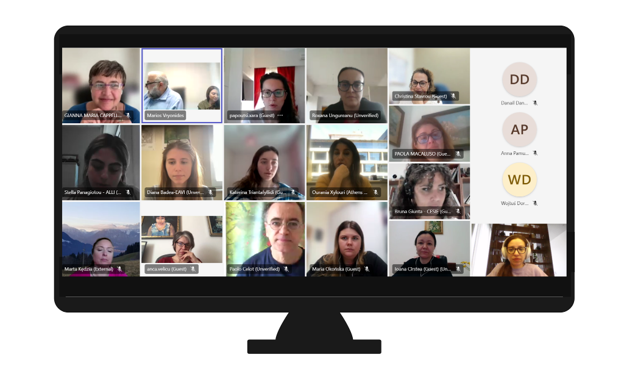

On April 12th, the National and Kapodistrian University of Athens (NKUA), specifically the Department of Pedagogy and Primary Education headed by the Chairman of the Department Konstantinos Skordoulis, launched the work for the development of two modules for the Teachers 4.0 Digital Curriculum in collaboration with the European University of Cyprus (EUC).
With the presence of Charis Xinari from EUC, the two partners had the chance to discuss about the important topic of digital [media] literacy and to lay the groundwork to start the creation of two of the ten very important modules, namely: “Disinformation: What are we talking about?” and “More key terms and definitions”.
The goal of the Teachers 4.0 Digital project is to create a thorough educational curriculum and a university course that will include all the required readings and materials to help educators and pre-service teachers address issues related to combating disinformation and promoting digital [media] literacy in their classrooms.
In today’s rapidly digitalized world, digital [media] literacy is crucial and is progressively influencing education. The rapidly changing media and information landscape, combined with the large number of online platforms and information sources, requires citizens not only to navigate the digital world with confidence, but also to be informed and critical. Promoting digital [media] literacy and tackling disinformation in classrooms and schools has never been more important than it is today. Both teachers/educators and students, regardless of grade level or type of school, are faced with an increasingly complex online environment in which there is more to read, hear and see than ever before.
Education and training can play a key role in equipping citizens with the skills needed to be critical in the online world. To ensure the effective development of digital media literacy and countering disinformation through the education and training process, teachers and trainers need to be further supported with guidance and practical examples.
In this direction, the work of the NKUA started on the development of the two current modules to provide practical exercises for teachers, including advice and activity plans to enhance understanding of how digital [media] literacy can be achieved and provide useful insights into the dynamics and manifestations of disinformation.
The modules will consist of learning outcomes, theoretical insight and activities/exercises to assess the student teachers’ pre-knowledge as well as activities/exercises to assess and evaluating students teachers’ learning. The aim is to strengthen their ability to address the problem of disinformation in classrooms and to work together to support youth in developing their resilience while enabling them to think critically, make wise decisions online, and be safe.