
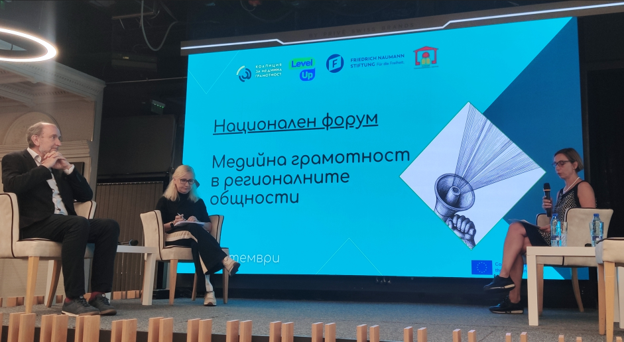
Long-term support and the active involvement of regional communities are essential for the sustainable development of media literacy and for reaching wider groups of citizens. This was the central message of the National Forum “Media Literacy in Regional Communities”, organised by the Media Literacy Coalition in partnership with the Friedrich Naumann Foundation for Freedom and the Global Libraries – Bulgaria Foundation.
The Forum brought together representatives of libraries, community cultural centres (chitalishta), schools, civil society organisations, public institutions and academia to discuss how successful local initiatives can receive more sustainable support, expand their reach and continue beyond individual project cycles.
Over the past decade, media literacy has increasingly developed from a primarily educational topic into a broader strategic priority. Alongside its established role in developing critical thinking, it is now closely connected to democratic resilience, countering disinformation, information integrity, digital transformation, artificial intelligence, and the safety of children online.
Local communities as a foundation for sustainable media literacy
A central theme of the Forum was the importance of local organisations and communities. Libraries, chitalishta, schools and civil society organisations often have direct knowledge of the needs of the people they serve, and can translate complex issues such as disinformation, online fraud and artificial intelligence into practical and accessible learning opportunities.
The Level Up project illustrates the potential of this community-based approach. During its pilot phase across three partner countries, more than 800 people participated, including 495 adults aged 60+ and 308 professionals. A total of 25 practical workshops were organised, alongside the development of five training modules, a trainer’s handbook, printed educational materials and an interactive game.
In Bulgaria, activities have been implemented through libraries, chitalishta and pensioners’ clubs. An important aspect of this work is the transition from participants being primarily recipients of information to becoming active members of their communities who can share what they have learned and support others in navigating the contemporary media environment.
From individual projects to long-term support
A major question discussed at the Forum was how successful initiatives can continue after the end of the project funding. Participants explored opportunities for European and national support and considered the conditions that make media literacy initiatives both effective and sustainable.
The discussions highlighted the need for more consistent public policies, adequate resources and stronger mechanisms connecting local experience with national institutions. In this context, the Media Literacy Council at the Bulgarian Ministry of Culture was identified as an important opportunity for continuous dialogue and cooperation among practitioners, civil society organisations and institutions.
Evaluation was also emphasised as an essential element of sustainability. The use of tools such as the European Digital Media Observatory (EDMO) guidelines for evaluating media literacy initiatives can help organisations assess not only immediate outcomes but also whether their activities contribute to measurable and lasting resilience to disinformation.
The Forum also drew attention to the broader conditions in which media literacy initiatives operate. Individual projects can respond to specific needs and fill important gaps, but long-term impact requires a more systematic approach combining public policy, institutional commitment, sustainable funding and cooperation between different sectors.
Learning from local good practices
Four good practices from Ruse, Botevo, Kurtovo Konare and Sofia demonstrated that significant expertise already exists at local level. Libraries and community cultural centres are working with specific groups and adapting their approaches to local needs.
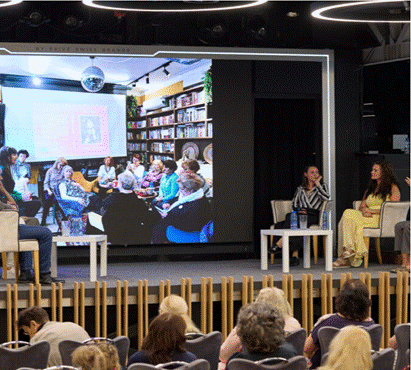
The initiatives presented ranged from training on recognising disinformation and online scams to activities supporting critical thinking and the safe use of digital resources. They showed that effective media literacy can be developed through organisations that are already trusted within their communities and understand the particular challenges faced by different groups.
To give greater visibility to such initiatives and support their further development, the Media Literacy Coalition and the Global Libraries – Bulgaria Foundation presented “Digital Stars in Regional Communities”, a new national distinction for initiatives that respond to real local needs, involve communities, demonstrate practical value and show potential for sustainability.
Applications will be open from March to June 2027, with the selected initiatives to be announced in September 2027.
Media literacy as a shared and long-term responsibility
The Forum concluded with the development of ideas for future joint initiatives and a discussion of the types of support most needed by local organisations.
One of the main conclusions was that media literacy cannot be developed sustainably through isolated projects alone. Long-term progress depends on consistent policies, stable partnerships, adequate resources and mechanisms that connect local knowledge and experience with national and European initiatives.
In an increasingly complex digital environment, media literacy also needs to respond to emerging challenges associated with artificial intelligence, algorithmically mediated information, online manipulation and rapidly changing forms of digital communication. Citizens therefore need not only digital skills but also the ability to critically evaluate information, recognise disinformation and manipulation, understand how digital technologies influence access to information, and make informed decisions about their participation in media environments.
The experience presented at the Forum demonstrates that strengthening media literacy requires a combination of individual competences, professional expertise, strong local communities and sustained institutional support. Building resilience to disinformation is therefore not only an educational task but a long-term collaborative effort involving schools, libraries, civil society, public institutions and local communities.
The National Forum “Media Literacy in Regional Communities” was organised within the Level Up project, funded by the Creative Europe Programme, in partnership with the Friedrich Naumann Foundation for Freedom and the Global Libraries – Bulgaria Foundation.