
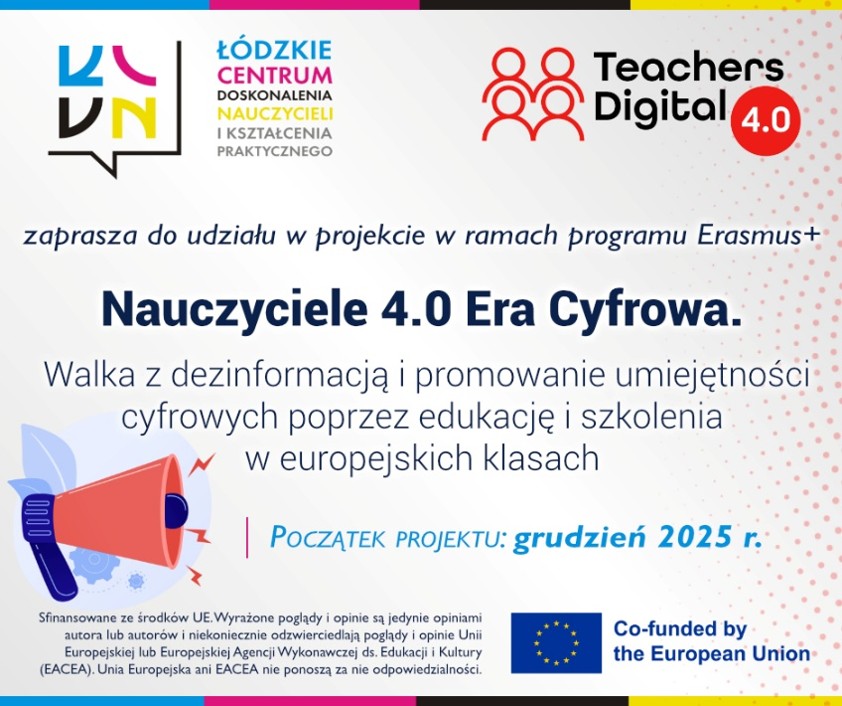
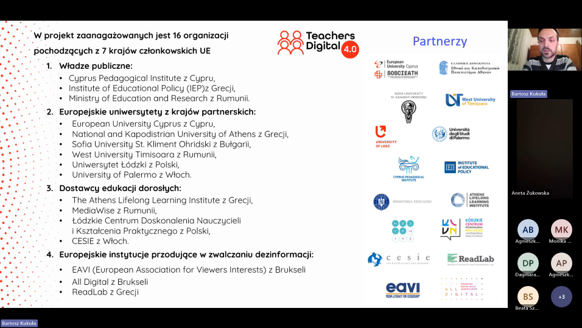
The Teachers 4.0 Digital Age – Tackling Disinformation and Promoting Digital Literacy project, implemented within the Erasmus+ programme, addresses one of the most pressing challenges faced by contemporary education systems: the growing impact of disinformation and the urgent need to strengthen digital literacy among educators. In an era where digital content is omnipresent and information spreads rapidly through online platforms, teachers play a crucial role in guiding learners toward critical, responsible, and informed use of digital media. The project responds directly to this need by supporting educators in developing competences that enable them to navigate, analyse, and teach about digital information environments.
Within this international initiative, the Polish partner is responsible for the implementation of a comprehensive training programme aimed at educators and education professionals. The training activities are designed to combine theoretical foundations with practical application, ensuring that participants not only understand the mechanisms of disinformation but are also equipped with concrete tools and strategies that can be transferred directly into educational practice. The activities are delivered online through a dedicated learning platform available at https://learn-teachers4digitalage.eu/, which serves as a central hub for learning, collaboration, and resource sharing.
The training programme has already entered its implementation phase. To date, training sessions have been launched for six groups of participants. At the current stage, training has begun for 118 participants, while overall interest in the programme continues to grow, with 133 participants registered so far. The project’s long-term objective is to train a total of 200 participants, ensuring broad outreach and meaningful impact within the educational community. The high level of interest observed at this early stage confirms the relevance of the project’s themes and the strong demand for professional development opportunities focused on digital literacy and countering disinformation.
The training sessions are delivered by three experienced trainers, each bringing distinct expertise and professional perspectives. This diversity of backgrounds enriches the learning process and allows participants to explore the topic of digital literacy from multiple angles, including pedagogical, technological, and social dimensions. The trainers work closely together to ensure coherence of content while maintaining flexibility to adapt sessions to the needs and experiences of each group. Their approach emphasises openness, dialogue, and mutual learning, creating a safe and supportive environment in which participants feel encouraged to ask questions, share challenges, and exchange best practices.
A defining feature of the training programme is its participant-centred and interactive methodology. Rather than relying on one-directional lectures, the sessions actively engage participants through discussions, group work, case studies, and practical exercises. Participants are invited to analyse real-life examples of misinformation and disinformation, reflect on their potential impact on learners, and collaboratively develop strategies for addressing these issues in educational contexts. This approach helps bridge the gap between theory and practice and ensures that learning outcomes are directly applicable to participants’ professional roles.
Throughout the sessions, particular attention is paid to the development of critical thinking skills and media awareness. Participants explore how digital content is created, distributed, and amplified, and how algorithms, emotions, and social dynamics influence the spread of information online. By understanding these mechanisms, educators are better prepared to help learners critically evaluate sources, recognise manipulation, and make informed decisions when consuming and sharing digital content. As one participant noted, “The training helped me understand not only what disinformation is, but why it works so effectively and how we can explain this to students in a clear and engaging way.”
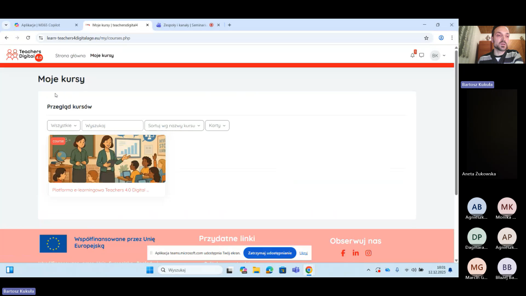
The online learning platform plays a central role in supporting the training process. It provides participants with access to learning materials, session recordings, additional resources, and practical tools that can be used during and after the training. The platform also facilitates ongoing communication between trainers and participants, enabling questions, feedback, and discussion beyond live sessions. This blended approach to online learning enhances flexibility and allows participants to engage with the content at their own pace. Many participants have highlighted the value of this feature, particularly in balancing professional responsibilities with continuous professional development. One participant reflected that “Having all the materials available on the platform makes it much easier to revisit the content and gradually implement new ideas in my teaching.”
Collaboration and peer learning are strongly embedded in the training design. Participants come from diverse educational backgrounds and represent different institutions, regions, and levels of experience. This diversity creates a rich learning environment in which participants can compare perspectives, learn from each other’s experiences, and collectively reflect on common challenges. Trainers actively facilitate this exchange by encouraging discussion and creating space for participants to share examples from their own practice. As one participant expressed, “Listening to how other educators deal with similar challenges in different contexts was one of the most valuable aspects of the training.”
Another important element of the programme is its focus on practical application. Participants are encouraged to think critically about how the concepts and tools presented during the sessions can be adapted to their own educational settings. Whether working with younger learners, adolescents, or adults, educators explore ways to integrate digital literacy topics into existing curricula and activities. This practical orientation ensures that the training has a lasting impact beyond the duration of the project. Participants leave the sessions not only with increased awareness, but also with concrete ideas and resources that can be immediately applied in their work.
Although the training activities are still at an early stage, initial feedback from participants has been highly positive. Many report increased confidence in addressing topics related to digital media, online safety, and disinformation with their learners. Participants also highlight greater awareness of their own role as educators in shaping responsible and critical digital citizens. The interactive format, combined with the expertise and openness of the trainers, has been identified as a key factor contributing to these outcomes. One participant summarised their experience by saying, “The sessions are very engaging and practical. I already feel better prepared to talk about difficult digital topics with my students.”
The Polish partner will continue to implement further training sessions in the coming months, gradually expanding the number of trained participants toward the target of 200. Future activities will build on the foundations established during the initial sessions, deepening participants’ competences and further strengthening the community of practice created through the project. Participant feedback will continue to play an important role in shaping the ongoing development of the training programme, ensuring that it remains relevant, responsive, and aligned with the needs of educators.
In addition to the direct impact on participants, the training activities implemented by the Polish partner contribute to the broader objectives of the Teachers 4.0 Digital Age project. By empowering educators with knowledge, skills, and confidence, the project supports the development of more resilient educational communities capable of responding to the challenges of the digital era. The focus on disinformation and digital literacy is particularly timely, as these issues increasingly affect not only education, but also democratic participation and social cohesion.
In conclusion, the training activities implemented by the Polish partner within the Teachers 4.0 Digital Age project have successfully moved from planning to practice. The strong level of interest, high participant engagement, and positive initial feedback demonstrate that the project is addressing real and urgent needs within the educational sector. Through an innovative online platform, a well-designed training programme, and the commitment of experienced trainers, the project lays the groundwork for long-term impact. As the training continues and the number of participants grows, the initiative is well positioned to contribute meaningfully to the promotion of digital literacy and the fight against disinformation across educational contexts.