
Author: Martina Natalini

  • From Romania to European classrooms: Learning from the digital lives of students

    From Romania to European classrooms: Learning from the digital lives of students

    At Mediawise Society, one of our key commitments within the Teachers 4.0 Digital project has been the development of Module 6: Exploring the Key Media Practices of Children and Students. We created this module from scratch, drawing on relevant research and theoretical frameworks to offer a comprehensive and engaging resource for teachers. Our work involved not only drafting the full theoretical content but also structuring it into a digestible e-learning experience, adding interactive elements such as online resources, videos, and quizzes, and ensuring that the material was fully adapted to the project’s digital platform.

    This process, part instructional design, part digital storytelling, offered an important reminder: in media and digital literacy education, how we present knowledge is just as crucial as the knowledge itself.

    From dense theory to “digestible learning”

    The original script for Module 6 was packed with theoretical perspectives: from constructivist learning and critical pedagogy to media ecology and the EU Kids Online model. It included insights from research and policy (UNCRC, General Comment No. 25), and positioned media practices as a gateway into understanding the rights, risks, and opportunities faced by young people in digital environments.

    For in-service teachers’ training, our task was to retain that academic depth while making the module accessible to busy teachers, many of whom may be encountering these frameworks for the first time. This meant:

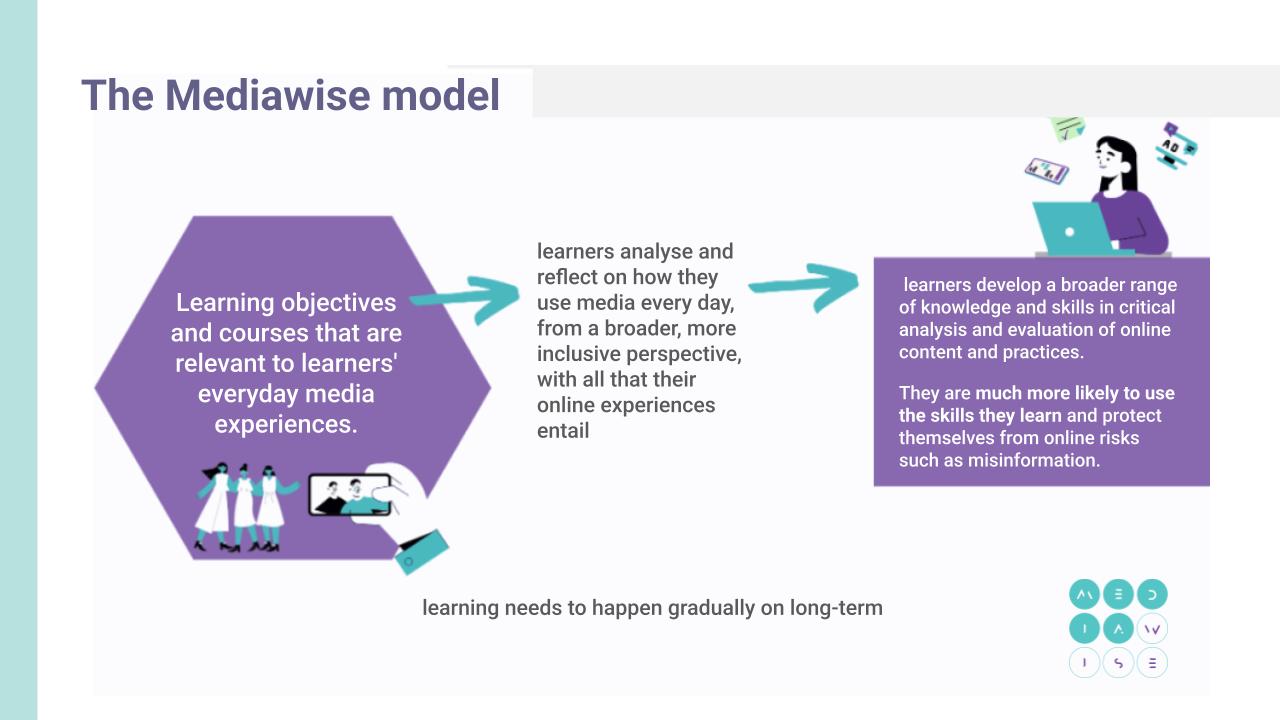
    • Segmenting the text into manageable, “bite-sized” units that follow the logic of digital learning. Instead of overwhelming readers with dense theory, we broke down key approaches, like constructivism, situated learning, and critical pedagogy, into short, focused sections. Each one comes with a clear heading, a quick explanation, and a direct connection to how it helps teachers connect with students’ digital lives.
    • We added videos, links, and real-world examples to bring abstract ideas to life, giving teachers quick ways to dive deeper without feeling overwhelmed.
    • Designing a final quiz that encourages reflective learning, not just factual recall. The final quiz goes beyond memorizing terms, it includes thought-provoking questions that challenge common assumptions and get teachers thinking critically about what they think they know about students’ digital habits.
    • Ensuring that the material felt relevant and actionable for educators across Europe. We made sure the content speaks to teachers everywhere by tying big ideas to practical classroom moves, like using students’ own media habits to spark discussions about disinformation, or exploring rights-based approaches through the UNCRC and General Comment No. 25. Real tools for real classrooms.

    This wasn’t just an editorial challenge but an exercise in empathy: How do we support teachers in understanding their students’ media cultures without overwhelming them?

    Why students’ media and digital practices matter

    One of the strongest messages in Module 6 is the value of starting from students’ own media habits when teaching about digital literacy, critical thinking, or disinformation.

    This idea, grounded in constructivist and culturally responsive pedagogies, reminds us that students are not blank slates. They are already immersed in the media. They already interpret, remix, and share information daily. Good media education doesn’t ignore this, it begins there.

    By building on students’ real-life digital experiences, teachers can create more engaging lessons, foster deeper learning, and even promote children’s rights in digital contexts (freedom of expression, participation, identity, privacy). This is particularly important in a time marked by information pollution, as students face not only disinformation but also subtle manipulations that shape their perceptions and identities online.

    Lessons learned from the process

    This contribution taught us a few things that we believe are worth sharing:

    1. Designing for teachers means respecting their time and professional expertise. Every extra paragraph or unclear concept is a potential barrier. Simplicity is not simplification, it’s a form of respect.
    2. Modules like this are more than training content. They are part of a broader cultural shift, helping educators feel more confident and better equipped to guide students through the complex media environments they live in.
    3. Even when developing a module from the ground up, the pedagogical choices we make (in structure, language, tone, and activity design) deeply shape how (and whether) the material resonates with its audience. Every decision, from the theoretical anchors selected to the way activities are framed, directly impacts how teachers engage with and apply the content in their classrooms.

    Looking ahead

    As the Teachers 4.0 Digital e-learning platform prepares for launch, we’re proud of our contribution not only to the development of Module 6 but also to the adaptation and translation of several other modules. Looking ahead, we’re excited to coordinate the continuous training of 200 teachers over the next year, a major step forward in helping educators bring media and digital literacy into their classrooms with confidence.

    This work wouldn’t be possible without the support and collaboration of our national partners, West University of Timișoara and the Ministry of Education and Research, who play a key part in advancing media education in Romania.

    We hope the course supports teachers in their daily work and inspires them to stay curious about their students’ digital lives, not as distractions, but as opportunities for connection, dialogue, and shared learning.

    Author: Flavia Țăran

  • Teachers 4.0 Digital Age: A Community of Educators Learningand Growing Together

    Teachers 4.0 Digital Age: A Community of Educators Learningand Growing Together

    In the autumn of 2025, we helped launch and implement the Teachers 4.0 Digital Age program, driven by the
    desire to create a meaningful learning space for educators eager to integrate media literacy and digital skills
    into their teaching. The program is now in full swing, and these first few months have already highlighted the
    profound need for such initiatives among teachers.
    3,799 teachers have joined the community and begun their training on the Teachers 4.0 online platform. The
    first two seminars have already taken place, providing participants with the opportunity to dive deeper into the
    course content and reflect together on their learning journey.


    Interest that Validates Our Mission
    Currently, the 3,799 enrolled educators represent every region of the country. This high level of engagement
    confirms that teachers are open to lifelong learning and dedicated to adapting their pedagogical practices to
    the realities of a deeply digitized world.
    For us, every enrolled teacher is more than just a statistic: they represent a newly trained specialist, a classroom
    of media-literate students, and a genuine drive to make education more relevant and connected to the present
    day.


    Profile of the Teachers 4.0 Community
    The community taking shape around this program mirrors the entire educational system: we bring together the
    energy of those at the start of their careers with the wisdom of veterans with over 20 years of experience. While
    the majority of participants come from primary education, early childhood education, and Romanian literature,
    we are joined by colleagues from all curricular areas and every corner of the country.
    Most participants are from primary (37%) and lower secondary (34%) education, where the dominant profile
    includes primary school teachers and specialists in Romanian language, mathematics, or foreign languages. In
    upper secondary education (28%), the largest share consists of teachers in the humanities, as well as biology
    and modern languages. This widespread participation shows that, regardless of the subject taught or the age of
    their students, teachers are eager to keep pace with the digital world to better support their students. This
    nationwide presence – spanning both urban and rural areas – proves that the desire for growth knows no
    geographical or professional boundaries.


    Teachers 4.0 Seminars – Spaces for Dialogue and Reflection

    A cornerstone of the program is the series of online seminars, designed as spaces for dialogue, reflection, and
    clarification. So far, teachers have participated in two sessions where they discussed key concepts from the
    online course and their practical application in the classroom.
    The second seminar was recently facilitated by Flavia Țăran, researcher and trainer in media literacy, Mediawise
    Teacher. The session was tailored for teachers currently progressing through modules 1-5 and focused on:

    • Discussing core concepts and their practical applicability;
    • Clarifying challenges encountered during the course;
    • Reflecting on the learning experience;
    • An open Q&A session.

    We are inspired by the active involvement of the teachers and the honest dialogue that emerges during these
    meetings.


    Looking Ahead
    The Teachers 4.0 Digital Age program will run until April 2026, featuring new seminars adapted to the
    participants’ stages of progress. Our goal is for this journey to remain flexible, relevant, and anchored in the real
    needs of educators. We continue this path alongside the teachers who believe in education, critical thinking,
    and preparing students for the digital world of today and tomorrow.


    The course is implemented in Romania by the Mediawise Society Association, in partnership with the Ministry of
    Education and the West University of Timișoara, with the National Audiovisual Council as an associate partner.
    It is supported by the French Ministry for Europe and Foreign Affairs through the French Embassy in Bucharest
    and is co-funded by the European Union.

  • From Romania to European Classrooms: Learning from the digital lives of students

    From Romania to European Classrooms: Learning from the digital lives of students

    Within the Teachers 4.0 Digital project, Mediawise Society was responsible for the development of Module 6: Exploring the Key Media Practices of Children and Students. The module was created from scratch, drawing on relevant research and theoretical frameworks to provide a comprehensive and engaging resource for teachers. This work involved not only the drafting of the full theoretical content, but also its structuring into a digestible e-learning experience. Interactive elements —such as online resources, videos, and quizzes were added, and the material was fully adapted to the project’s digital platform.

    This process —part instructional design, part digital storytelling —served as a reminder that, in media and digital literacy education, the way knowledge is presented is just as important as the knowledge itself.

    From Dense Theory to “Digestible Learning”

    The original script for Module 6 incorporated a wide range of theoretical perspectives— from constructivist learning and critical pedagogy to media ecology and the EU Kids Online model. It included insights from research and policy (UNCRC, General Comment No. 25), and positioned media practices as a gateway into understanding the rights, risks, and opportunities faced by young people in digital environments.

    For in-service teachers’ training, the challenge was to preserve the academic depth of the content while making the module accessible to busy teachers, many of whom may be engaging with these frameworks for the first time. This required:

    • Segmenting the text into manageable, “bite-sized” units aligned with the principles of digital learning. Rather than overwhelming readers with dense theory, key approaches —such as constructivism, situated learning, and critical pedagogy — were broken into short, focused sections. Each section includes a clear heading, a concise explanation, and a direct link to how it supports teachers in engaging with students’ digital lives.
    • The inclusion of videos, links, and real-world examples to bring abstract concepts to life, offering teachers accessible ways to dive deeper without feeling overwhelmed.
    • The design of a final quiz intended to promote reflective learning rather than simple factual recall. The quiz moves beyond the memorisation of terms and includes thought-provoking questions that challenge common assumptions and get teachers thinking critically about what they think they know about students’ digital habits.
    • Ensuring that the content felt relevant and actionable for educators across Europe. The material was carefully aligned with practical classroom applications—for example, using students’ own media habits to stimulate discussions about disinformation or exploring rights-based approaches through the UNCRC and General Comment No. 25. Real tools for real classrooms.

    This process represented more than an editorial challenge; It was also an exercise in empathy: How can teachers be supported in understanding their students’ media cultures without becoming overwhelmed?

    Why Students’ Media and Digital Practices Matter

    One of the central messages in Module 6 is the importance of beginning with from students’ own media habits when teaching about digital literacy, critical thinking, or disinformation.

    This approach, grounded in constructivist and culturally responsive pedagogies, emphasises that students are not blank slates. They are already immersed in media environments—regularly interpreting, remixing, and sharing information. Effective media education does not overlook this reality; rather, it takes it as a starting point.

    By building upon students’ real-life digital experiences, teachers can create more engaging lessons, encourage deeper learning, and even promote children’s rights in digital contexts—such as freedom of expression, participation, identity and privacy. This approach is especially relevant in an era characterised by information pollution, in which students are exposed not only to disinformation, but also to subtle manipulations that influence their perceptions and identities online.

    Lessons Learned from the Process

    1. Several insights emerged during the development of this contribution that are considered valuable to share: Designing for teachers means respecting their time and professional expertise. Every extra paragraph or unclear concept is a potential barrier. Simplicity should not be mistaken for simplification — it’s a form of respect.
    2. Modules of this kind represent more than just training content. They contribute to a broader cultural shift, empowering educators to feel more confident and better prepared to support students navigating complex media environments.
    3. Even when a module is developed from the ground up, the pedagogical choices made —relating to structure, language, tone, and activity design — have a significant impact on how (and whether) the material resonates with its intended audience. Every decision, from the theoretical foundations to the framing of activities, directly influences how teachers engage with and implement the content in the classrooms.

    Looking ahead

    In the coming year, Mediawise Society will coordinate the continuous training of 200 teachers—a significant step towards integrating media and digital literacy into classrooms with confidence.

    The course is designed to support teachers in their daily practice and to foster continued curiosity about students’ digital lives—not as distractions, but as opportunities for connection, dialogue, and shared learning. This work has been made possible through the collaboration of Mediawise Society’s national partners, including the West University of Timișoara and the Ministry of Education and Research, both of whom play an essential role in advancing media education in Romania.

  • Teachers 4.0 Digital Curriculum: Available now to empower teachers in digital media literacy

    Teachers 4.0 Digital Curriculum: Available now to empower teachers in digital media literacy

    Digital literacy and tackling disinformation are among the top three digital skills needed for the 21st century. Teachers need to be equipped with the necessary knowledge and skills to empower their students to think critically, make informed choices online and stay safe whilst continuously building their resilience in the digital world.

    Teachers 4.0 Digital offers a large-scale capacity-building activity for initial training and continuous professional development of teachers and educators across Europe with a focus on Bulgaria, Cyprus, Greece, Italy, Poland and Romania.

    For the past one year of our project, 34 established academics from 9 European universities and institutions have been developing an exclusive and thorough University Course entitled ‘Tackling Disinformation and Promoting Digital Media Literacy through Education and Training’.

    Our comprehensive program spans 60 hours of immersive learning, divided into two parts:
    30 hours of hands-on instruction and 30 hours of self-guided exploration, offering a blend of theory and practical application.

    Drawing inspiration from the latest educational frameworks and the digital needs of tomorrow, the curriculum is divided into 10 dynamic modules that will unlock new possibilities for teaching in the digital world.

    Module 1 – Introduction
    Gain an insightful overview of the course, its objectives, and the powerful methodologies behind it.

    Module 2 – Disinformation: What Are We Talking About?
    Learn to distinguish disinformation, explore key concepts like participatory culture, echo chambers, and the filter bubble, and see how disinformation threatens democracy, democratic institutions, and equal digital participation.

    Module 3 – More Key Terms and Definitions
    Dive into essential digital media literacy terms like troll, phishing, cheapfake, deepfake, and verification. With an interactive glossary and hands-on activities, learners will not only grasp these concepts but also develop the skills to spot and tackle misinformation in the digital world.

    Module 4 – Setting the Scene for Teaching and Learning in the Digital School Environment
    Learn how to create a safe space for discussing sensitive topics and understand your role in guiding these important conversations with your students.

    Module 5Assessing and Evaluating Digital Media Literacy in Schools
    Gain practical tools and strategies to evaluate and enhance your students’ digital skills.

    Module 6 – Explore the Key Media Practices of Children and Students
    Learn why connecting with your students’ digital lives matters, and how their online experiences shape their worldviews. Discover a framework for analysing their media habits and interactive activities to help them reflect on their own media behaviors in a fun way!

    Module 7 – Teaching Digital Media Literacy and Disinformation
    Equip Students with critical media skills!Find out how to help students understand media texts, spot bias, use fact-checking techniques, and create responsible media, empowering them to become digital citizens.

    Module 8 – Building Digital Media Literacy Competences in the Classroom: Becoming Digital Citizens
    Explore how to equip students with essential digital media literacy skills, focusing on responsible online behavior, critical thinking, and safe digital practices.

    Module 9 – Students in All Their Diversity
    Gain insights on how to address diversity in the classroom, understanding its importance and how misinformation impacts different social groups. Practical activities are included to help engage students and foster inclusive learning environments.

    Module 10 – Practical Examples of Lesson Plans
    Learn about an instructional model to help teachers create effective lesson plans and offers practical examples that can be used, adapted, or serve as inspiration to guide students toward becoming responsible digital citizens.

    All the modules are accompanied by suggested teaching methods and tools suitable for our target group and consistent with the course goals.

    Follow us on LinkedInFacebookInstagram!

  • Transforming Education with Digital Media Literacy

    Transforming Education with Digital Media Literacy

    Education must change to prepare students for a future dominated by information and in today’s rapidly changing digital landscape. The ability to critically evaluate, create, and engage with digital content responsibly has made digital media literacy an essential skill It is no longer an optional enhancement but a fundamental requirement for developing informed citizens and skilled professionals in the 21st century.

    Fact-checking, media analysis, ethical digital behaviour, and recognising reliable sources are just a few of the skills that make up digital media literacy.  Given the prevalence of social media and the growing risks of misinformation and digital manipulation, students must learn to access and assess digital information effectively. IIn a world where technology drives communication, collaboration, and career opportunities, digital competency is essential.

    Benefits of Integrating Digital Media Literacy in Education

    The benefits of incorporating digital media literacy into the classroom are numerous. By encouraging independent thought and teaching students to question and evaluate online content, it enhances critical thinking skills and reduces their vulnerability to misinformation. Furthermore, it fosters responsible digital citizenship by raising awareness of privacy, digital ethics, and the consequences of online behaviour, helping students develop a respectful and accountable online presence.

    Using digital tools to create multimedia content also boosts engagement, storytelling abilities, and creative thinking, further encouraging innovation. Additionally, it promotes fair learning opportunities, ensuring all students receive digital literacy education and are prepared for the evolving job market, contributing to closing the digital divide. Lastly, integrating media literacy into education equips students with essential digital fluency, an increasingly vital skill for modern careers, ensuring they are well-prepared for professional success.

    Implementing Digital Media Literacy in Schools

     To fully integrate digital media literacy into education, educational institutions and teachers must implement effective strategies. Digital literacy must be integrated into existing disciplines rather than being taught as a stand-alone subject. Promoting experiential learning allows students to apply their knowledge in real-world contexts by creating blogs, films, and podcasts.

    Teacher preparation is essential to ensure educators receive comprehensive training on guiding students through digital environments ethically and effectively. Collaboration with digital businesses, media outlets, and academic institutions can provide students with practical experience and real-world insights. Involving parents is also crucial, schools should offer workshops and resources to help parents understand digital best practices and challenges, reinforcing media literacy at home.

    The Role of the Teachers 4.0 Digital Project

    .  The Teachers 4.0 Digital project aims to equip teachers with the resources and expertise needed to integrate digital media literacy into their lesson plans. By providing comprehensive training, the project ensures that educators can effectively guide students through the complexities of digital engagement. This approach fosters a generation that is not only technologically proficient but also capable of critical thinking and responsible digital behaviour.

    By emphasizing media literacy, the project transforms how teachers and students engage with digital technology, driving educational innovation.

    This shift is essential for the future of education,  where digital media literacy will became a core part of the curriculum rather than just an add-on.

    Partnership with the Institute of Educational Policy (IEP)

    A key partner of the Teachers 4.0 Digital project is the Institute of Educational Policy (IEP), the official scientific advisor to the Ministry of Education in Greece. The IEP plays a crucial role in shaping and improving educational policies and practices, particularly in primary and secondary education. Its main responsibilities include:

    1. Curriculum Design and Development: Creating national curricula and drafting school textbooks to ensure high-quality education standards.
    2. Scientific Research and Studies: Conducting research and evaluations to enhance education quality, address student dropout rates, and promote inclusivity.
    3. Teacher Training and Professional Development: Organizing training programs to enhance teachers’ skills and familiarize them with modern teaching methods.
    4. Policy Advisory and Implementation Support: Providing scientific and technical assistance to the Ministry of Education to ensure alignment with national and international quality standards.

    Through its collaboration with the Teachers 4.0 Digital project, the IEP contributes significantly to advancing digital media literacy by supporting teacher training initiatives, curriculum development, and educational research. This partnership ensures educators have the necessary resources and guidance to implement effective digital literacy practices in classrooms.

    Digital media literacy is a key pillar of modern education, shaping students into informed, responsible, and creative online citizens. Ensuring the next generation can navigate and contribute meaningfully to the digital world requires collaboration between parents, educators, policymakers, and schools.

    Initiatives such as Teachers 4.0 Digital lay the foundation for a future where students are not just consumers of digital content but ethical participants and critical thinkers in the digital age.

  • Pre-Service Teacher Training: First session successfully delivered!

    Pre-Service Teacher Training: First session successfully delivered!

    Empowering Future Educators: The First Teachers 4.0 Digital Training Session at UniPA

    During the autumn semester (October–December 2024), the University of Palermo (UniPA) hosted the first pre-service teacher training session of the Teachers 4.0 Digital project. The session was designed and delivered by Gianna Cappello, Full Professor of Sociology of Education and Digital Media at the Department of Psychology, Educational Science and Human Movement. She manages the project for UniPA, along with Daniela Sortino and Paola Macaluso, both members of the UniPA project team.

    The course focused on the Teachers 4.0 Digital Curriculum on Digital Media Literacy and Tackling Disinformation, coordinated by UniPA and implemented in collaboration with European partner universities and institutions. The curriculum aims to equip teachers with methodologies and tools to enhance students’ competencies in identifying and addressing disinformation, misinformation, and malinformation, as well as understanding echo chambers and conspiracy theories. Additionally, it provides strategies for assessing and evaluating digital media competencies in schools.

    The Teachers 4.0 Digital Curriculum was offered as study material, with specific insights and activities from Modules 2, 3, 5, and 6. All self-study resources were shared with students, along with guidelines for group projects, which were presented and discussed during the final course examinations. Some of the most outstanding projects developed by Italian students featured a wealth of original materials for future classroom lesson plans and activities. These included:

    • Echo Chambers and Conspiracy Theories
    • Appearances Can Be Deceiving: Discovering Cheap Fakes and Deep Fakes
    • Navigating with Awareness: From Disinformation to Digital Responsibility
    • The Conspiracy Factory on the Web: Beware of Echo Chambers!
    • Behind the Scoop: Truth and Invention

    A total of 178 UniPA students participated in the course, which was part of the Teachers 4.0 Digital Project.

  • Teachers 4.0 Digital: Reshaping the Educational Landscape – The case of Bulgaria

    Teachers 4.0 Digital: Reshaping the Educational Landscape – The case of Bulgaria

    Today’s first-grade students are expected to enter the labor market in approximately 10 to 15 years. Some researchers indicate that the advancement of artificial intelligence (AI) by that time is likely to render numerous professions obsolete, making them a thing of the past. Consequently, educational systems must adapt to this paradigm shift by prioritising the development of competencies that align with the demands of the 21st century. Specifically, schools must integrate competencies in critical thinking, creativity, digital media literacy, and emotional intelligence into the core curriculum.

    Despite the growing recognition of these needs, some schools in Bulgaria continue to rely on traditional pedagogical approaches, which often emphasise rote memorisation and repetition rather than fostering essential skills such as teamwork, problem-solving, and the ability to view diversity as an opportunity rather than a challenge.

    Although somewhat delayed, the present time is opportune for such innovations. In recent years, several initiatives have been successfully implemented within the country to advance the modernisation of education. These include the successfully fulfilled European projects like the “European Safe Online Initiative” and the “European Media Coach Initiative,” which promote sustainable development in media pedagogy and media literacy. Some other national initiatives like the educational program “Design Champions” aim to transform students from passive recipients of knowledge to active participants in their learning processes. These projects and initiatives are designed to foster a paradigm shift among educators, equipping them to address future challenges in the educational system. By providing educators with the essential tools and knowledge in media literacy, they will be better equipped to help students effectively use digital tools and cyberspace for their personal development and growth.

    In this context, the Teachers 4.0 Digital project that aims to promote digital media literacy at European schools emerges as a significant initiative aimed at reshaping the educational landscape. Our project aims to equip both current and future educators with the necessary tools to navigate and contribute to educational transformation. As one of the partners, Sofia University “St. Kliment Ohridski” is piloting a training program for students across various pedagogical disciplines, intending to modernise Bulgarian education to meet the needs of contemporary learners.

    Further supporting these efforts, the recent development of the “Guidelines for Recommended Screen Time for the Use of Digital and Media Content by Adolescents” created by a diverse group of specialists – including psychologists, educators, media experts, and IT professionals – under the auspices of the Bulgarian Council for Electronic Media (CEM), marks a pivotal step forward. These guidelines provide much-needed direction for parents and educators in managing the challenges posed by digital platforms and screens.

    Collectively, these initiatives and projects signal a significant shift in Bulgaria’s educational system, moving from conceptual frameworks to actionable reform strategies – an essential step for ensuring the success and sustainability of educational advancements.

  • Teachers 4.0 Digital Empowers Future Educators: First Insights from the University Course on Digital Media Literacy

    Teachers 4.0 Digital Empowers Future Educators: First Insights from the University Course on Digital Media Literacy

    In a rapidly evolving digital world, educators stand at the frontline of shaping a generation capable of navigating the complexities of online information. Recognising this vital role, the Teachers 4.0 Digital project is paving the way for a transformative approach to education.

    As proud partners of this groundbreaking initiative, the National and Kapodistrian University of Athens (NKUA), through its Department of Pedagogy and Primary Education, is leading the charge in equipping future teachers with the tools they need to combat disinformation and foster digital resilience in classrooms across Europe.

    The Mission: Digital Media Literacy for the Future

    Teachers 4.0 Digital is more than just a project: it’s a movement towards empowering educators to become champions of digital media literacy. By tackling pressing challenges like disinformation, the initiative is designed to help students develop critical thinking skills and resilience in an era where misinformation spreads faster than ever before.

    The core of this project lies in a comprehensive, 60-hour curriculum tailored to meet the needs of pre-service teachers. The course curriculum, developed collaboratively by the project’s partners, is designed to be a game-changer in education. Structured into 10 engaging modules, the curriculum introduces innovative methods and practices to help future educators:

    • Identify and debunk disinformation,
    • Foster digital and media literacy,
    • Build resilience against the influence of false information,
    • Effectively integrate digital tools in education.

    This comprehensive approach ensures that the pre-service teachers not only grasp the concepts but are also equipped with actionable strategies to make a lasting impact in their classrooms.

    A Pilot Phase Full of Promise

    At NKUA, the pilot implementation of this innovative course is currently underway. Pre-service teachers -university students preparing to become educators- are engaging in a dynamic learning experience that is both challenging and inspiring. Their enthusiasm is palpable as they delve into the course material, which blends theory with hands-on applications to address real-world challenges.

    Through interactive sessions, collaborative projects, and insightful discussions, the students are not only enhancing their own digital media literacy but are also gaining the necessary skills to pass on these critical competencies to their future students.

    I feel empowered to be a part of this course. The strategies we’re learning are so practical and engaging. I can already see how they will transform my future classroom”, shared Aggeliki, a participating student.

    Inspiring a Digital-Ready Generation

    As part of a broader European collaboration, the Teachers 4.0 Digital project brings together educators, researchers, and institutions to address one of the most pressing challenges of our time: ensuring that the next generation is well-equipped to navigate the digital world responsibly and effectively.

    The pilot phase at NKUA marks a significant milestone in realising this vision, with pre-service teachers leading the way as enthusiastic participants in this transformative journey.

    As this initiative continues to grow, the impact of the curriculum will extend beyond the university, influencing classrooms and communities across Europe. Together, we are building a brighter, more informed future -one classroom at a time. By fostering a culture of critical thinking and digital media literacy, this project aims to revolutionise how education addresses the challenges of the 21st century.

    The future of education is here, and it’s more exciting than ever! Stay tuned for updates on this exciting journey and see how Teachers 4.0 Digital is shaping the future of education in the digital age!

  • Teachers 4.0 Digital: One Year of Advancing Digital Media Literacy in Education!

    Teachers 4.0 Digital: One Year of Advancing Digital Media Literacy in Education!

    The month of December marks the first anniversary of our project and we would like to take this opportunity to celebrate our progress with you!

    The Teachers 4.0 Digital project aims to equip teachers with the necessary knowledge and skills to empower their students to think critically, make informed choices online and stay safe whilst continuously building their resilience in the digital world. The project partners work together to achieve the following objectives:

    • Development of a comprehensive curriculum that will guide teachers and educators in the ways they may teach their students the necessary skills to thrive in the digital age.
    • Design of a University course on the topic of combating disinformation and digital literacy: In addition to integrating elements of digital literacy into all initial teacher education courses, a specific course on combating disinformation, building resilience, as well as digital and information literacy is developed as a separate course.
    • Development of an e-Learning platform for the upskilling of thousands of primary and secondary school education teachers and educators to offer the Teachers 4.0 Digital course in a blended learning format in six European languages: Bulgarian, English, Greek, Italian, Polish and Romanian.

    A curriculum for digital media literacy

    The first year of our project was dedicated to the development of a curriculum containing teaching, learning and assessment material with practical examples of lesson plans, as well as key terms and definitions. The curriculum  corresponds to a total of sixty (60) training hours (30 hours for direct instruction and 30 hours for individual study) consisting of the following modules:

    • Introduction
    • Disinformation: What are we talking about?
    • More key terms and definitions
    • Setting the Scene: Teaching and learning in the digital school environment
    • Assessing and evaluating digital literacy in schools
    • Explore the key media practices of children and students
    • Teaching digital media literacy and disinformation
    • Building digital media literacy competences in the classroom and school: becoming digital citizens
    • Students in all their diversity
    • Practical examples of lesson plans

    Our curriculum is now ready in English and will be released by the beginning of next year in all project languages (Bulgarian, Greek, Italian, Polish and Romanian).

    University courses

    Our two partners University of Palermo (UNIPA) and National and Kapodistrian University of Athens (NKUA) started implementing the Teachers 4.0 Digital University course in their universities. Here are their first insights from this elective course that attracted 170 students so far:


    – The young pre-service teachers who have just started the course has a great interest and enthusiasm, acknowledging its usefulness for their future collaboration with young students who are surrounded with social media.

    – It is very much inspiring to see their strong position towards social media and digital media use, with a motivation to deal with disinformation and misinformation to take a leading role in empowering their future students to do the same.

    E-Learning Platform

    Development of our e-learning platform is also going at full speed: During the last few months, the project partners brainstormed about how to offer the most accessible and user-friendly capacity-building experience. We are excited to launch our platform in the coming months to upskill the primary and secondary school education teachers and educators in six European languages.

    What’s next?

    The ultimate aim of the project is the delivery of a large-scale upskilling activity involving over 2.000 in-service teachers/educators and teachers-to-be in the countries involved to help them:

    • acquire knowledge and skills related to digital literacy,
    • update their knowledge on contemporary media used by children and adolescents,
    • change their attitudes towards the role, importance and future implications of contemporary media
    • strengthen their commitment to promote digital literacy in their classrooms

    Our project aims to create a wider impact by initiating a public debate with the involvement of all relevant stakeholders, contributing to a policy reform on digital literacy education at national and European levels, and providing a comprehensive capacity-building framework for teachers on issues relating to tackling disinformation and promoting digital literacy.

  • Annual Academic Conference on AI Application in Higher Education

    Annual Academic Conference on AI Application in Higher Education

    Application of artificial intelligence (ChatGPT and/or other platforms) in the field of humanities was the topic of a two-day conference, organized by the Faculty of Classical and Modern Philology, Sofia University. The conference, held in a blended format at Belchin Gardens Resort, 29-30 November 2024, joined the participation of over 20 academics and researchers, working in Bulgaria, Australia and Japan.

    The initiative was opened by Prof. Madeleine Danova, vice-rector of Sofia University, who made a review and an in-depth analysis of the AI application at the Faculty, focusing on the advantages and challenges faced during the current year. On the one hand, she stressed on the positive impact of AI in regard to the increased overall efficiency of academic work, and on the other hand, she touched the issue of plagiarism and ethics-related violations made by students when using AI.

    Dr. Mario Bozhilov, from the Queensland University, Australia made a key-note speech on the AI application in higher education, tacking into consideration the advantages and disadvantages of the most frequently used AI platforms.

    Japanese experience of AI application in the field of history was the topic touched upon by Associate Professor Evgeni Kandilarov from Tokyo University, who talked about the research opportunities of AI usage in analyzing the value of historical monuments.

    Other presentations related to AI usage in Language Models Construction, Challenges of AI application in the field of Bulgarian Studies, and Perspectives in AI usage in the humanities were intensively discussed by the forum participants.

    Prof. Danail Danov presented Teachers 4.0 Digital project, which caught the attention of all the Departments Heads attending the conference. The majority of them declared their readiness to offer as an elective discipline the project curriculum in the academic schedule of their students, teachers-to-be during the summer term of 2025. Various opportunities of integrating Teachers 4.0 Digital modules in the qualification programs aimed at teachers at all educational levels were also discussed.

    The conference participants supported the idea of publishing a collection of the materials presented as a good opportunity to promote AI application among broader audiences.